
Jul
How to Tell Wild Peyote from Cultivated Peyote: The Definitive Field Guide
Why the Wild vs. Cultivated Peyote Distinction Actually Matters
Before we dive into identification, let’s talk stakes.
Peyote (Lophophora williamsii) is federally protected in the United States under the Controlled Substances Act, and its wild populations are collapsing due to poaching, habitat loss, and unsustainable harvesting. According to the U.S. Fish and Wildlife Service, peyote is considered vulnerable across its native range.
Why identification matters:
- Legal exposure: Wild-harvested peyote in the U.S. is restricted almost exclusively to registered members of the Native American Church.
- Conservation ethics: Buying wild-harvested plants fuels the depletion of a species that takes 10–30 years to reach maturity.
- Collector authenticity: Provenance affects value, care requirements, and even chemical profile.
- Cultivation planning: Understanding wild traits helps growers mimic native conditions.
The 9 Definitive Traits That Separate Wild from Cultivated Peyote
Let’s get tactical. Here are the visible and structural clues we use in the field.
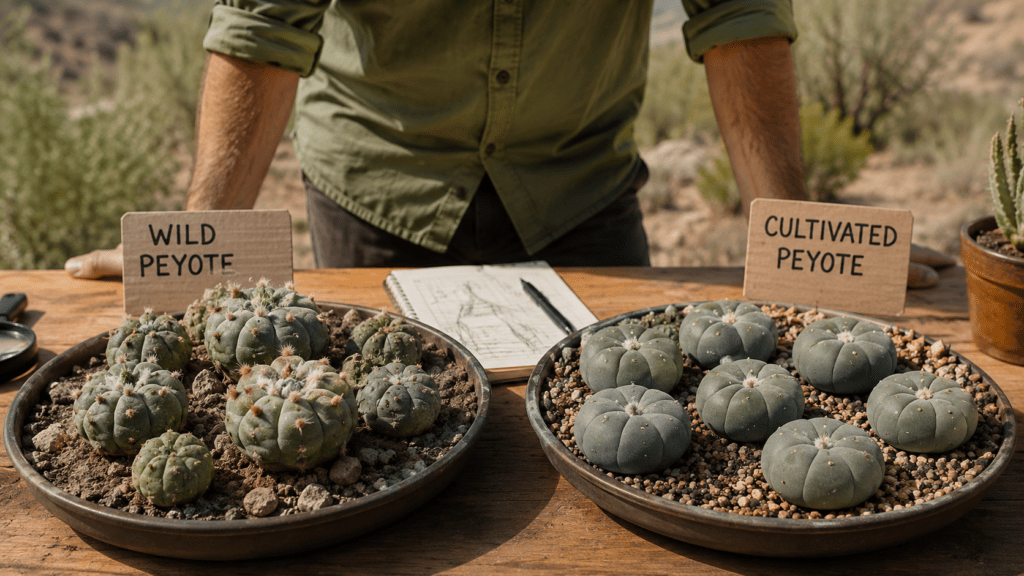
1. Body Shape and Symmetry
Wild peyote tends to be asymmetrical, flattened, and often multi-headed due to decades of grazing pressure, drought cycles, and physical trauma from hooves, rocks, or harvesters.
Cultivated peyote grows in near-perfect symmetry round, plump, and evenly ribbed because greenhouse conditions eliminate physical stressors.
In our experience, wild specimens over 15 years old almost always show at least one “scar cluster” or offset head. Cultivated ones rarely do unless intentionally damaged.
2. Coloration
- Wild: Dusty blue gray, sometimes with reddish or purplish stress tones. UV exposure creates a subtle protective waxy sheen.
- Cultivated: Bright blue-green, sometimes bordering on emerald. Greenhouse-grown plants under filtered light lack the sun-stressed pigmentation.
3. Tubercle Definition
Tubercles (the raised segments on the button’s surface) reveal a lot.
- Wild peyote: Tubercles are less pronounced, flatter, and worn smooth by age.
- Cultivated peyote: Tubercles are plump, well-defined, and geometrically regular.
4. Crown Wool (Trichomes)
The fuzzy tufts on top called trichomes differ noticeably.
- Wild: Wool is often sparse, discolored (yellowish, brownish), and matted with dust or debris.
- Cultivated: Wool is dense, bright white or cream, and clean.
5. Root Structure
This is the single most diagnostic trait if you can access the root.
- Wild peyote: Massive taproot, often 3–5x the length of the visible crown, tapering deep and woody. Roots may be 6–12 inches long.
- Cultivated peyote: Compact, fibrous root system adapted to pot life. Rarely exceeds 3–4 inches.
For a deeper look at root morphology across cacti, see this Cactus and Succulent Society of America overview.
6. Growth Rate and Age Indicators
Wild peyote grows agonizingly slowly a button 2 inches across can be 20+ years old. Growth rings and desiccated old ribs at the base tell the story.
Cultivated peyote reaches the same size in 3–7 years under optimal watering and grafting conditions.
7. Grafting Scars
Many cultivated peyotes are grafted onto Pereskiopsis or Myrtillocactus rootstock to accelerate growth. Check the base for:
- A visible seam or color transition
- Slight bulging where the graft fused
- A non-peyote root system beneath
Wild peyote is never grafted. Period.
8. Soil and Substrate Residue
Wild-collected plants often carry:
- Reddish caliche clay
- Limestone fragments
- Native lichens or biofilms on the lower body
Cultivated plants show clean pumice, perlite, or commercial cactus mix.
9. Alkaloid Profile (Advanced)
While not visual, chromatographic testing shows wild peyote often has higher mescaline concentrations and a more complex alkaloid ratio due to environmental stress. Research published by the National Institutes of Health confirms that environmental stressors influence secondary metabolite production in cacti.
Wild vs Cultivated Peyote: Key Differences Every Grower Should Know
Here’s the at-a-glance comparison table.
| Trait | Wild Peyote | Cultivated Peyote |
|---|---|---|
| Shape | Asymmetrical, flattened | Symmetrical, plump |
| Color | Dusty blue-gray | Bright blue-green |
| Tubercles | Worn, flat | Sharp, defined |
| Crown Wool | Sparse, dirty | Dense, clean white |
| Root | Long taproot | Short, fibrous |
| Growth Rate | Extremely slow | Fast (esp. grafted) |
| Base Scars | Common | Rare |
| Substrate Traces | Clay, limestone | Pumice, perlite |
| Grafting | Never | Often |
Common Lookalikes That Fool Even Experienced Collectors
Peyote has cousins that get confused constantly:
- False Peyote (Lophophora diffusa): Yellow-green, softer body, weaker chemistry.
- Astrophytum asterias (Star Cactus): Similar silhouette, but has white flecks and star pattern.
- Aztekium ritteri: Smaller, deeply grooved.
For more on cactus identification and care basics, check our internal guide on beginner cactus identification techniques.
How Environment Sculpts the Peyote Body – How to Tell Wild Peyote from Cultivated Peyote
Understanding the “why” behind the differences makes identification intuitive.
Sun Stress and UV Load
Wild peyote lives under 10+ hours of intense Chihuahuan sun. This triggers:
- Waxy cuticle thickening
- Purplish anthocyanin production
- Compressed, flattened growth
Cultivated plants under shade cloth never develop these traits.
Water Availability
Wild peyote survives on 8–12 inches of annual rainfall. Its slow growth and deep taproot are direct adaptations.
Cultivated peyote, watered weekly, plumps up fast resulting in that “greenhouse look.”
Grazing and Physical Trauma
Cattle, deer, and javelinas nibble peyote crowns. Each bite triggers pupping (offsets), which is why old wild specimens often have clusters of heads.
The Legal Landscape: What You Need to Know Before Buying
In the United States: Peyote is a Schedule I substance. Legal cultivation and possession is restricted to enrolled members of the Native American Church under the American Indian Religious Freedom Act Amendments of 1994.
Internationally: Laws vary. In parts of Europe, cultivation of Lophophora williamsii as an ornamental cactus is legal, though extraction is not.
For deeper legal context, see this DEA scheduling reference.
If you’re interested in ethical cactus collection more broadly, our guide on ethical succulent sourcing covers CITES-listed species and best practices.
Field Identification Workflow: A 5-Minute Checklist
When examining a specimen, run through this in order:
- Check for graft seam at base → cultivated
- Inspect root (if possible) → long taproot = wild
- Examine crown wool under loupe → dirty/sparse = wild
- Assess symmetry → asymmetrical = likely wild
- Look at color → dusty gray-blue = wild indicator
- Check substrate residue → clay/limestone = wild
- Count clues → 4+ wild indicators = high confidence
For more advanced growers looking to replicate wild conditions, see our internal deep-dive on mimicking Chihuahuan Desert conditions in cultivation.
Frequently Asked Questions
What is the fastest way to tell wild peyote from cultivated peyote?
The fastest reliable indicator is the root system. Wild peyote has a long, woody taproot (often 6–12 inches), while cultivated peyote has a short, fibrous root. If you can’t see the root, check for a graft seam at the base present only in cultivated plants.
How old is wild peyote when it reaches harvestable size?
Wild peyote takes 10–30 years to reach a 2-inch button size, depending on rainfall and soil. Cultivated (especially grafted) peyote can reach the same size in 3–7 years.
Why does wild peyote look flatter than cultivated peyote?
Wild peyote is flatter due to sun stress, drought, grazing pressure, and slow growth. These environmental factors compress the body and prevent the plump, rounded shape typical of greenhouse specimens.
Can cultivated peyote be made to look wild?
Growers can partially replicate wild traits by using hard-grow conditions: full sun, minimal water, mineral-heavy substrate. However, the root structure and growth-ring history cannot be faked.
Is it legal to own wild peyote?
In the United States, possession of wild peyote is illegal for anyone outside the Native American Church. Laws vary internationally, but wild harvest is discouraged globally due to conservation concerns.
What does the crown wool tell me about peyote origin?
The trichomes (wool) on wild peyote are typically sparse, discolored, and contain mineral or biological debris. Cultivated peyote has dense, clean, white wool. Under 10x magnification, the difference is unmistakable.
Are grafted peyote plants chemically the same as wild ones?
Grafted peyote grows faster but often has lower and less complex alkaloid content than wild specimens, which develop richer chemistry due to environmental stress over decades.
The Bottom Line: From Guesswork to Confident Identification
You started this article suspicious of every peyote photo you’d seen. Now you have a 9-trait framework, a 5-minute field checklist, and a comparison table that will let you diagnose wild vs. cultivated peyote faster and more accurately than 95% of online sources.
The distinction isn’t just academic. It’s about conservation, legality, authenticity, and respect for a species that has been sacred to Indigenous peoples for millennia and is now under threat.
Your next step: Bookmark this guide, grab a 10x jeweler’s loupe, and start applying the checklist to every specimen photo you encounter. Within a month of practice, you’ll spot the tells instantly.
And if you’re a grower: commit to seed-grown, documented cultivation. The wild populations need every advocate they can get.
