
Blog
Ideal Lighting Requirements for Peyote Cactus Growth
Aug
What Are the Ideal Lighting Requirements for Peyote Cactus Growth?
If you are trying to cultivate Lophophora williamsii (Peyote), you already know it is a supreme test of patience.
You also likely know the frustration of watching a healthy, plump green button suddenly turn a stressed purple, or worse, scorch into a permanent, woody white scar. We agree: getting the lighting right is the single hardest variable in cactus cultivation. Most online guides fail you by offering vague advice like “give it bright indirect light,” which leaves you guessing and leaves your cactus vulnerable.
The Ecological Truth About Peyote Cactus Light Requirements
To understand how to light your cactus indoors or in a greenhouse, you must first understand how it survives in the wild.
Novice growers often assume that because peyote comes from the Chihuahuan Desert, it wants to be blasted by the scorching midday sun. This is a fatal misconception.
In its natural habitat, peyote is an understory dweller. It grows almost exclusively beneath the canopy of “nurse plants” like mesquite bushes, creosote, or agave. These larger plants provide vital dappled shade, protecting the slow-growing cactus from intense UV radiation.
According to research from the University of Arizona Cooperative Extension on Desert Microclimates, nurse plants can reduce soil temperatures by up to 15 degrees and filter out up to 60% of direct solar radiation. Your goal as a grower is to replicate this “nurse plant” effect.
Ideal Lighting Requirements for Peyote Cactus Growth: Stage-by-Stage Guide
Peyote cactus light requirements change drastically as the plant matures. Treating a three-month-old seedling the same as a ten-year-old adult will result in catastrophic failure.
Here is the exact blueprint for every stage of your plant’s life.
1. The Seedling Stage (0 to 12 Months)
Peyote seedlings are incredibly delicate. In nature, they germinate in the deep, moist shade of rocks and brush. If exposed to direct sunlight, they will boil and die within hours.
- Light Intensity: Very low to moderate. Aim for 2,000 to 4,000 Lux (roughly 200 to 400 foot-candles).
- Photoperiod (Duration): 12 to 14 hours of light per day.
- Indoor Setup: Use T5 fluorescent tubes or dimmable full-spectrum LEDs. Place the lights at least 12 to 18 inches above the humidity domes.
- Color Temperature: 6500K (cool white) is ideal for encouraging stout, structural growth rather than stretching.
2. The Juvenile Stage (1 to 3 Years)
As your cacti reach the size of a dime to a nickel, they begin to develop their thick taproot and a tougher epidermis. They are ready for more light, but the transition must be gradual.
- Light Intensity: Moderate. Aim for 10,000 to 15,000 Lux.
- Photoperiod (Duration): 12 to 14 hours during the growing season.
- Outdoor Transition: If moving outdoors, place them in heavy, bright shade. They should never see direct sunlight during the peak hours of 10:00 AM to 4:00 PM.
- Indoor Setup: Lower your LED lights slightly or increase the dimmer switch by 10-15%.
3. The Adult Stage (3+ Years)
Adult peyote are highly resilient, but they still prefer the dappled shade of their ancestral nurse plants. Getting the lighting right at this stage encourages flowering and robust, flattened growth.
- Light Intensity: High, but filtered. Aim for 25,000 to 40,000 Lux.
- Photoperiod (Duration): 12 to 14 hours in summer. Allow a natural reduction to 8 to 10 hours in winter to trigger dormancy.
- Outdoor Setup: Provide morning sun and afternoon shade. If kept in a greenhouse, a 30% to 50% aluminized shade cloth is absolutely mandatory.
Indoor vs. Outdoor: Mastering the Environment
Whether you are cultivating on a windowsill in New York or in a backyard in Texas, you must tailor your lighting strategy to your specific environment.
Indoor Cultivation: The Artificial Sun
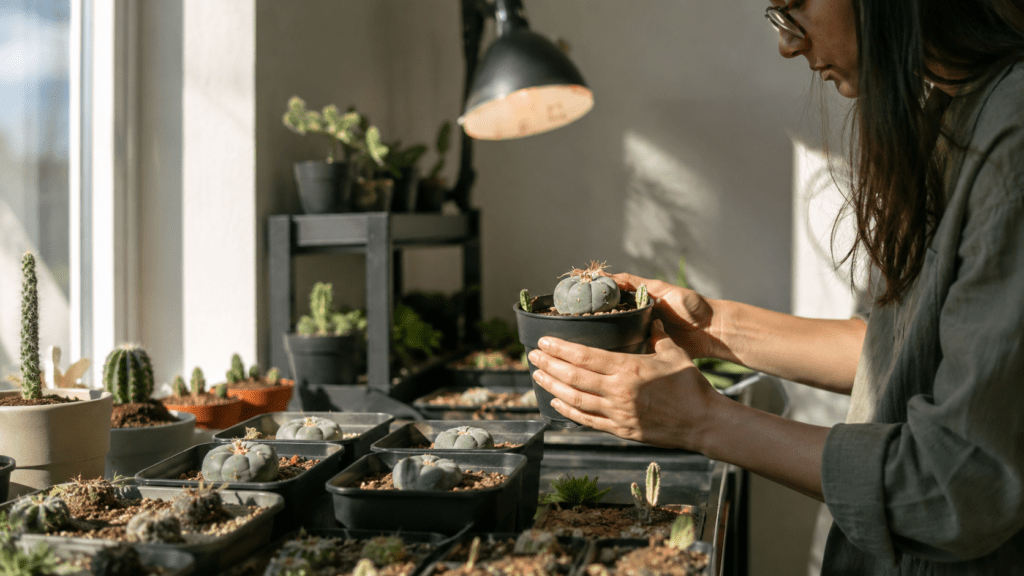
Growing Lophophora indoors gives you god-like control over their environment, but it requires the right equipment. Windowsills are rarely sufficient; they either provide too little light (causing stretching) or too much magnified heat (causing burns).
Choosing the Right Grow Lights:
- Full-Spectrum LEDs: The modern gold standard. They run cool, use minimal electricity, and provide the exact wavelengths needed for photosynthesis. Look for quantum boards with Samsung LM301B/H diodes.
- PAR and PPFD: Don’t just look at wattage. You want a PPFD (Photosynthetic Photon Flux Density) of about 200-300 µmol/m²/s for adults.
- Distance: Keep LEDs 18 to 24 inches away from adult plants. Use a lux meter app on your phone to dial in the exact intensity at the canopy level.
Outdoor Cultivation: Harnessing the Real Sun
Outdoor cultivation yields incredibly natural-looking, hard-grown specimens, but the sun is an untamed beast.
The Shade Cloth Strategy:
According to the Royal Horticultural Society’s guidelines on arid plants, controlling ambient light and heat is vital. You cannot just put a peyote on a patio table.
- 30% Shade Cloth: Ideal for northern latitudes where the sun is less intense.
- 50% Shade Cloth: Mandatory for southern latitudes (Texas, Arizona, Florida, California) to prevent scorching.
Signs Your Peyote is Getting the Wrong Light
The beautiful thing about Lophophora williamsii is that it communicates with you. It will visually tell you if your ideal lighting requirements for peyote cactus growth are off-balance.
You just need to know how to listen.
Symptoms of Too Much Light (Phototoxicity)
When peyote receives too much light, it initiates protective mechanisms, followed by cellular damage.
- Anthocyanin Production (Red/Purple Colors): Before a cactus burns, it produces anthocyanins. This acts as a natural “sunscreen,” turning the epidermis a deep red, purple, or bronze. If your green cactus turns purple, immediately move it to a shadier spot. It will revert to green in a few weeks.
- Sunburn (Bleaching): If the red warning signs are ignored, the plant will burn. Sunburn appears as stark white, yellow, or beige patches on the skin facing the light source.
- Wrinkling/Deflation: Extreme light brings extreme heat, causing the cactus to rapidly transpire and shrink into the soil.
(Are you watering your stressed cactus correctly? Read our [Internal Link: Masterclass on Watering Desert Cacti] to avoid compounding light stress with root rot).
Symptoms of Too Little Light (Etiolation)
A cactus starved of light will desperately reach for it. This is called etiolation, and the damage is permanent.
- Stretching/Coning: A healthy peyote is shaped like a flat, squashed pumpkin. A light-starved peyote will begin to grow upward, resembling a cone, a cylinder, or a cucumber.
- Pale Green/Yellow Center: The new growth at the apex (center) of the plant will look highly pale, weak, and yellowish compared to the dark green base.
- Stalled Growth: The plant simply stops doing anything for months on end.
Expert Corner: The Acclimatization Strategy (Hardening Off)
The number one killer of adult Lophophora is moving them from an indoor winter setup to an outdoor summer setup too quickly.
Even if your indoor LEDs are incredibly bright, they do not produce the intense UV radiation of the actual sun. Moving a plant from an LED tent directly to an outdoor patio will result in third-degree sunburn in under three hours.
The 3-Week Hardening Off Protocol:
- Week 1: Place the cactus outside in 100% deep, heavy shade. Let it adjust to the temperature swings and ambient UV rays.
- Week 2: Move the cactus to a spot that receives only 1 to 2 hours of very early morning sun (7:00 AM to 9:00 AM), then deep shade for the rest of the day.
- Week 3: Move the cactus beneath its permanent 40% to 50% shade cloth, or to its permanent morning-sun location.
Always monitor for the red/purple stress coloration during this process. If you see it, step back to the previous week’s lighting.
Frequently Asked Questions (FAQ)
To ensure you have no lingering doubts, we’ve answered the most common questions regarding peyote cactus light requirements.
What is the best type of grow light for peyote?
The best indoor light is a dimmable, full-spectrum LED quantum board (mimicking 6500K daylight). They are highly energy-efficient, run cool, and provide the exact spectrum necessary for healthy, flat growth. T5 fluorescent tubes are a close second, particularly for seedlings.
How many hours of light does a peyote cactus need?
During the active growing season (Spring and Summer), peyote requires 12 to 14 hours of light per day. During the winter dormancy period, this should be reduced to 8 to 10 hours to simulate natural seasonal changes.
Can peyote grow in low light?
No. While they are shade-loving desert plants, “desert shade” is still significantly brighter than the interior of a normal house. If grown in true low light, the cactus will etiolate (stretch upward), become weak, and eventually die from a weakened immune system.
Why is my peyote turning red or purple?
Red or purple coloration is a stress response to excessive light or cold. The plant is producing anthocyanins to act as a natural sunscreen. You should immediately reduce the light intensity or provide more shade to allow the plant to recover its green color.
When should I change my lighting schedule?
You should adjust your lighting schedule to mimic the seasons. Increase to 14 hours of light in the spring when you begin watering again. Decrease to 10 hours in the late autumn when you stop watering to induce winter dormancy.
How do I measure light for my peyote?
The most practical way for home growers is to download a free “Lux Meter” app on your smartphone. While not perfectly accurate, it gives you a solid baseline. Aim for 2,000-4,000 lux for seedlings, and 25,000-40,000 lux for adults.
Can peyote survive under a regular desk lamp?
No. Standard incandescent or weak LED desk lamps do not provide the necessary Photosynthetic Active Radiation (PAR). The plant will stretch and deform. You must use a dedicated horticultural grow light.
Conclusion: Mastering the Light
Cultivating Lophophora williamsii is an incredibly rewarding journey, but it requires strict attention to environmental details.
By understanding the ideal lighting requirements for peyote cactus growth, you are no longer relying on guesswork. You now know that these plants are understory dwellers that crave dappled, filtered light. You have the exact lux and photoperiod metrics for seedlings, juveniles, and adults. Most importantly, you know how to read the plant’s stress signals to prevent fatal sunburn and irreversible stretching.
