
Aug
Peyote Seasonal Care Guide: How to Support Growth Year Round Without Risking Root Rot?
Growing Lophophora williamsii is incredibly rewarding, but let’s agree on one undisputed fact: managing its seasonal transitions can be downright nerve-wracking.
One wrong move with the watering can in the middle of winter, and you are staring down the barrel of irreversible taproot rot.
But it doesn’t have to be a guessing game. In this guide, I promise to give you a bulletproof, month-by-month framework that removes the anxiety from seasonal cactus cultivation.
We will uncover exactly how to wake your plant up in the spring, push maximum growth in the summer, and safely tuck it away for a hard winter dormancy.
How do we know this works? In our decades of collective experience studying hard-grown desert cacti, this exact environmental mirroring strategy has consistently produced flawless, deeply rooted specimens.
Let’s dive into the ultimate system for cultivating a masterpiece.
Why You Need a Strict Peyote Seasonal Care Routine
If you treat a peyote cactus like a standard indoor houseplant, it will perish. Period.
Unlike tropical aroids that tolerate consistent year-round moisture, Lophophora williamsii has evolved over millennia in the harsh, unforgiving climate of the Chihuahuan Desert.
Their biology is strictly dictated by extreme seasonal shifts.
To cultivate them successfully at home, your job isn’t to “tame” the plant. Your job is to act as Mother Nature, artificially recreating the intense dry seasons and the brief, torrential monsoon seasons of their native habitat.
Spring Care: Waking Up from the Winter Sleep
Spring is the most critical transition period for your cactus.
As daylight hours increase and temperatures begin to rise, your peyote will slowly emerge from its shriveled, dormant winter state.
However, rushing this process is the number one cause of rot and sunburn among amateur growers. You must wake the plant up deliberately and systematically.
The Critical First Spring Watering
Do not simply drench the soil the moment the calendar hits March.
Wait until the nighttime temperatures consistently stay above 50°F (10°C) and the daytime temperatures reach into the 70s (21°C+).
Start with a light surface misting. We call this “teasing the roots.” It signals to the dormant taproot that the dry season is ending.
Wait an entire week after this initial misting. If the weather remains warm, you can proceed with your first deep, saturating bottom-water.
Light Acclimation to Prevent Sunburn
During winter dormancy, your cactus loses its tolerance to intense ultraviolet light.
If you move it directly from a dim winter windowsill into blazing spring sun, the epidermis will scorch, leaving permanent, unsightly white or brown scarring.
Use shade cloth to filter the light, or move the plant progressively closer to your primary light source over a three-week period.
Target an initial light intensity increase of no more than 20% per week.
Spring Feeding and Fertilization
Desert cacti are not heavy feeders. Their native limestone soils are incredibly poor in organic nutrients.
However, offering a highly diluted fertilizer during the first few spring waterings can kickstart robust, compact growth.
Use a low-nitrogen, high-phosphorus, and high-potassium fertilizer (like a 2-7-7 NPK ratio).
Dilute the fertilizer to exactly one-quarter (1/4) of the manufacturer’s recommended strength to avoid chemical root burn.
Summer Care: Managing the Active Growth Phase
Summer is when your Lophophora packs on bulk, develops its beautiful blue-green glaucous coating, and produces its iconic pinkish-white flowers.
Your primary goal during the summer is to maximize growth without pushing the plant beyond its biological limits. Heat is your friend, but stagnant humidity is your enemy.
Summer Watering Protocols and CAM Photosynthesis
During peak summer, you can water your peyote more frequently usually once every 10 to 14 days but only if the soil dries out completely between soakings.
Pro-Tip: Always water in the late evening.
Cacti utilize Crassulacean Acid Metabolism (CAM) photosynthesis. To conserve water, they keep their stomata (pores) closed during the blazing hot day.
They only open their pores at night to breathe and absorb moisture. Evening watering aligns perfectly with their natural biological rhythm.
Heat Management and Airflow
Peyote thrives in daytime temperatures ranging from 80°F to 100°F (27°C to 38°C).
However, high heat combined with zero airflow creates a highly localized greenhouse effect that can literally boil the plant in its pot.
If you are growing indoors or in a greenhouse, you must utilize oscillating fans.
Continuous airflow dramatically increases the evaporation rate of your soil, mitigating the risk of fungal pathogens.
Pest Prevention Strategies
Summer heat brings out the most notorious cactus pests: spider mites and thrips.
These microscopic pests pierce the epidermis, sucking out sap and leaving behind a rusty, cork-like scarring on the skin.
Inspect the crown (the center where new growth emerges) weekly with a jeweler’s loupe.
If you spot webbing or crawling dust, treat immediately with a horticultural soap or a targeted miticide. Avoid using heavy neem oil in direct sunlight, as it will cause severe phototoxicity.
Autumn Care: Preparing for the Big Sleep
As late September and October roll around, the angle of the sun drops, and nighttime temperatures begin to cool.
This is the transition phase. Your goal here is to carefully pump the brakes on the active growth cycle.
Failing to properly prepare your cactus for winter is a recipe for disaster.
Tapering Off the Water
As soon as the autumn nights drop below 60°F (15°C), you must drastically reduce your watering frequency.
Cut your watering schedule in half immediately.
If you were watering every two weeks, stretch it to every four weeks. Furthermore, stop bottom-watering completely.
Transition to light top-watering so the moisture stays shallow and evaporates rapidly.
Temperature Drops and Environmental Cues
To induce proper dormancy, the plant needs to “feel” the impending winter.
Allow the plant to experience the natural nighttime temperature drops of autumn.
According to botanical experts at the University of Texas at Austin Lady Bird Johnson Wildflower Center (External Link), exposing native Texan cacti to these cooling cues is vital for hardening off the plant tissue.
By late November, the soil must be bone-dry. Not damp. Not slightly moist. Bone-dry.
Peyote Seasonal Care Guide: How to Support Growth Year Round
(This section addresses the overarching strategy of year-round continuity).
To truly master the Peyote Seasonal Care Guide: How to Support Growth Year Round, you must view the four seasons not as isolated events, but as a continuous, interconnected cycle.
What you do in the winter dictates how the plant will flower in the summer.
If a plant does not achieve a deep, restful winter dormancy, it will often refuse to flower the following spring.
Conversely, if a plant does not receive adequate heat and moisture during the summer, it will lack the stored energy reserves necessary to survive the harsh winter drought.
Year-round support means constantly anticipating the next season.
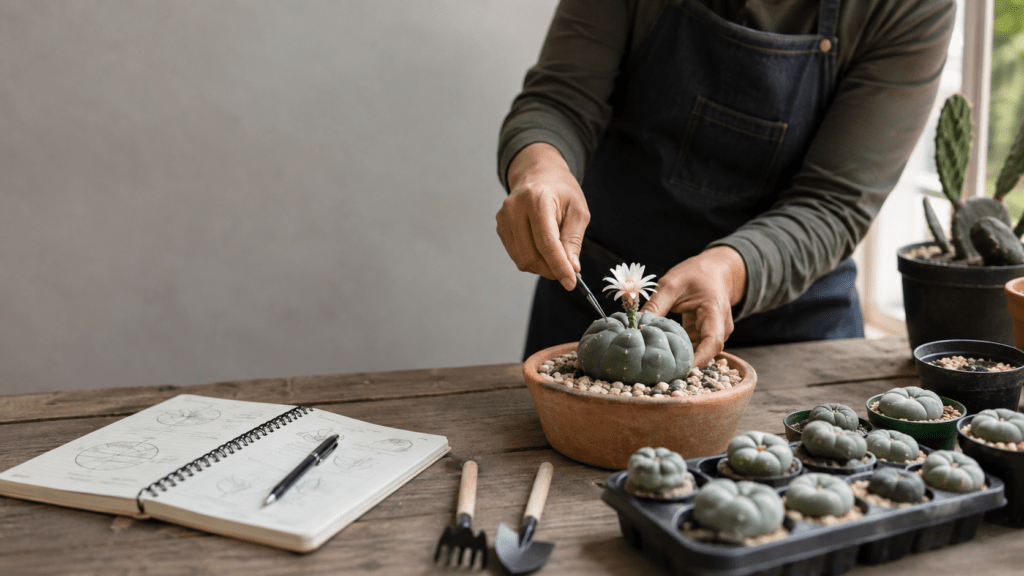
Keep a cultivation journal. Track your watering dates, the local temperature highs and lows, and the specific date your plant breaks dormancy. Over time, this data becomes your ultimate cheat sheet.
Winter Care: Mastering the Hard Dormancy Phase
Winter is the most psychologically difficult season for the indoor grower.
For three to four months, you must ignore every instinct you have as a plant parent.
You must starve the plant of water and let it sit in the cold. This “hard dormancy” is absolutely essential for the long-term health of Lophophora williamsii.
The Absolute Zero-Water Rule
From December through February, your peyote should receive exactly zero drops of water.
During this time, you will notice the cactus becoming squishy, deflated, and wrinkled.
Do not panic. This is a brilliant evolutionary survival mechanism.
The plant is purposely expelling water from its cells, concentrating its internal sap to act as a biological anti-freeze. If you water it to “plump it up,” the cells will engorge, freeze, and rupture, killing the plant instantly.
Temperature Requirements for Dormancy
To keep the plant completely dormant, you must keep it cool.
Aim for winter resting temperatures between 45°F and 55°F (7°C to 12°C).
If you keep the plant in a heavily heated living room at 75°F (24°C), the plant will attempt to continue growing.
Because winter daylight is weak, this warm-weather growth will stretch and become horribly deformed (a process known as etiolation).
Preventing Winter Etiolation
If you cannot provide cool temperatures and are forced to keep your plant in a warm room over the winter, you must provide intense supplemental grow lighting.
Without high-output LED lighting, the warm temperatures will confuse the plant into growing without adequate solar energy.
The plant will turn into a pale green, cone-shaped mess.
If keeping it cold isn’t an option, keep it blasted with artificial light for 12 hours a day to keep the growth tight and compact.
Expert Corner: Soil and Potting Variables That Impact Seasonal Care
You cannot master seasonal care if your foundation—the soil—is flawed.
In a standard organic potting soil, even the best seasonal watering schedule will fail because the soil holds moisture for far too long.
To support year-round growth safely, you need a highly specialized, predominantly inorganic mineral mix.
The Ultimate Mineral Soil Recipe
We highly recommend a mix that is at least 80% to 90% inorganic.
A professional, root-safe mix should consist of:
- 40% Pumice: Provides excellent aeration and structure.
- 30% Calcined Clay or Turface: Holds onto just enough moisture and fertilizer while draining rapidly.
- 10% Crushed Limestone: Replicates the alkaline soils of the Chihuahuan Desert.
- 10% Coarse River Sand: Aids in drainage (never use fine play sand, which turns into concrete).
- 10% Earthworm Castings: The only organic component, providing gentle, slow-release nutrients.
Pot Selection for Taproots
Lophophora williamsii is a subterranean plant.
In the wild, 80% of the plant’s mass is hidden underground in the form of a massive, carrot-like taproot.
Therefore, shallow terra-cotta pans are entirely unsuitable.
You must use deep “taproot pots” or tall nursery pots. Furthermore, always ensure the pot has massive drainage holes. Unglazed ceramic or terra-cotta is vastly superior to plastic, as the porous clay breathes, pulling moisture out of the soil to accelerate drying times.
For authoritative insights on desert soil compositions, you can study the horticultural practices detailed by San Marcos Growers (External Link), who masterfully cultivate xeric plants.
[Internal Link Suggestion: Anchor text “Choosing the Right Pot for Taproot Cacti” linking to your pot selection guide]
Frequently Asked Questions (FAQ)
To ensure you have every detail locked down, we’ve answered the most common questions regarding the seasonal cycle of your cactus.
What temperature is too cold for peyote during winter dormancy?
While dormant and completely dry, Lophophora williamsii can briefly survive temperatures dipping down to 30°F (-1°C). However, for safe home cultivation, never let the ambient temperature drop below 40°F (4°C) to completely eliminate the risk of frost damage to the crown.
How do I know if my peyote needs water in the summer?
Use the “squeeze test.” Gently pinch the sides of the cactus. If it feels rock-hard like an apple, do not water it. If it feels slightly pliable or has a slight “give” to it, and the soil is bone-dry all the way to the bottom of the pot, it is ready for a deep watering.
Why is my peyote turning yellow at the base?
A yellowing base is often the first, terrifying sign of taproot rot, usually caused by overwatering during the autumn or spring transition phases. Stop watering immediately, unpot the plant, inspect the root for mushy brown tissue, and allow it to dry bare-root in a shaded area.
When is the best time of year to repot my cactus?
The optimal time for repotting is late winter or very early spring, just before the plant breaks dormancy. Repotting while the plant is asleep ensures that any minor root damage sustained during the process has time to callous and heal before the first spring watering is introduced.
Can peyote grow strictly indoors year-round?
Yes, but it requires highly specialized equipment. To grow indoors year-round, you must mimic the seasonal changes using a programmable grow tent. You will need high-intensity full-spectrum LED lights, heating mats, and oscillating fans, while manually altering the light hours and temperatures to simulate the changing seasons.
Conclusion: Your Path to Flawless Cultivation
Successfully cultivating Lophophora williamsii is not a matter of a green thumb; it is entirely a matter of systematic discipline.
By mastering the Peyote Seasonal Care Guide: How to Support Growth Year Round, you are no longer blindly reacting to your plant’s needs.
You are proactively steering its environment.
You now know how to gently awaken it in the spring, push its limits during the hot summer, responsibly taper it down in the autumn, and enforce a strict, dry discipline during the winter dormancy.
Implement these exact frameworks, switch to a heavy mineral soil mix, and respect the biological rhythms of the desert. If you do, you will cultivate hard-grown, flawless specimens that outlive you.
