
Blog
Peyote cactus growing tips
Jul
Peyote Cactus Growing Tips: The Definitive Cultivation Guide That Actually Works
Why Peyote Is Different From Every Other Cactus You’ve Grown
Most “cactus care” advice treats all succulents the same. That’s why beginners fail with Lophophora.
Peyote evolved in the Chihuahuan Desert limestone soils of south Texas and northern Mexico high pH, mineral-rich, sparse organic matter. It has a massive taproot relative to its crown, and a growing season sharply defined by monsoon rains and cold winters.
Miss any of these three variables substrate, hydration timing, or dormancy and your plant stalls or dies.
Key Takeaway: Peyote isn’t hard to grow. It’s hard to grow the way most guides tell you to.
The Ultimate Peyote Cactus Care Guide: Foundations First
Before we get into tips, let’s lock in the four non-negotiable pillars.
1. Substrate: Mineral-Heavy, Alkaline, Fast-Draining
The single biggest failure point in peyote cultivation is soil. Standard “cactus mix” from garden centers holds too much moisture and is often slightly acidic.
Our proven mix (by volume):
- 40% pumice or lava rock (2–5mm)
- 20% coarse perlite
- 20% crushed limestone or oyster shell grit
- 15% coco coir or sifted peat
- 5% worm castings
Target pH: 7.2–8.0. Test with a cheap pH meter this alone will separate you from 90% of hobbyists.
Expert Corner: In our experience, adding a tablespoon of gypsum per gallon of mix mimics the calcium sulfate content of native soils and noticeably firms up the epidermis.
2. Containers: Deep, Not Wide
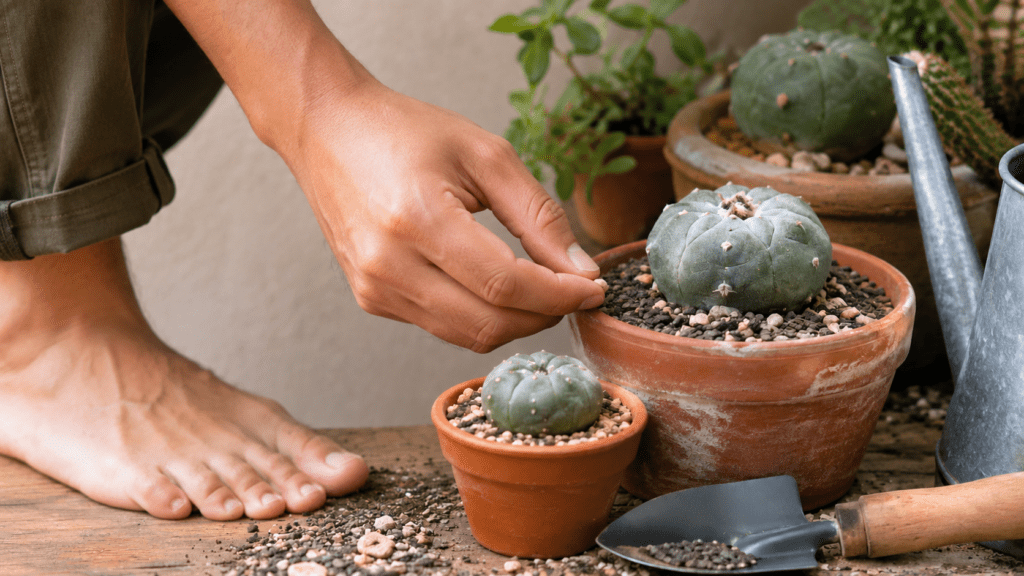
Peyote’s taproot can grow 3–5x longer than the crown is wide. Use tall pots minimum 4 inches deep for seedlings, 6+ inches for adults. Terracotta breathes better than plastic and prevents root rot.
3. Light: Bright, But Not Brutal
Wild peyote often grows tucked under nurse plants like Larrea tridentata (creosote). It wants strong light but not the naked midday sun of a Phoenix rooftop.
- Ideal: 60–70% full sun, or 20,000–35,000 lux
- Indoor LED: 150–250 PPFD, 12–14 hour photoperiod in growing season
- Warning sign: Yellowing or reddish-purple stress coloration = too much light
4. Temperature & Dormancy
- Growing season (spring–early fall): 70–95°F (21–35°C)
- Winter dormancy (Nov–Feb): 40–55°F (4–13°C), completely dry
Skipping dormancy is the #2 reason mature plants never flower. More on this below.
Peyote Cactus Growing Tips: 17 Techniques That Move the Needle
Here’s the tactical heart of this guide the working protocols we use.
Tip #1: Sow Seeds in a Sealed Humidity Chamber
Peyote seeds germinate best at 75–85°F with 90%+ humidity. Use the Takeaway/Fielder method: sow on the moistened substrate in a clear plastic container, seal it, and don’t open for 4–6 weeks.
Tip #2: Bottom-Water, Never Top-Water Seedlings
Top-watering displaces seeds and invites fungus gnats. Set pots in a tray of dechlorinated water for 15 minutes until surface darkens.
Tip #3: Add a Fungicide to Your Seed-Starting Water
We use a mild chamomile tea or diluted hydrogen peroxide (1 tsp/quart) to prevent damping-off. Chinosol at 0.1% is the professional standard.
Tip #4: Wait to Prick Out
Don’t transplant seedlings until they’re at least 6–12 months old and the size of a lentil. They’re extremely fragile before that.
Tip #5: Water Deeply, Then Wait
During growing season, drench the pot fully then wait until the substrate is bone dry all the way through. For adults in 4-inch pots, that’s typically 10–21 days.
Pitfall Alert: “A little water often” is the fastest way to rot a peyote. This is not a houseplant.
Tip #6: Use the Squeeze Test
Gently squeeze the plant between two fingers. Firm = hydrated. Soft or wrinkled = time to water. This works better than any moisture meter.
Tip #7: Fertilize Lightly During Active Growth
Use a low-nitrogen, high-potassium cactus fertilizer (something like 2-7-7 or 5-10-10) at 1/4 strength, once every 4–6 weeks from April through August.
Tip #8: Never Fertilize a Dry or Dormant Plant
Salt buildup burns the taproot. Flush the pot with plain water every 3–4 months.
Tip #9: Enforce a Real Winter Dormancy
Move plants to an unheated garage, cold frame, or cool basement window from November through February. Withhold water entirely. This triggers next-season flowering.
Tip #10: Graft to Accelerate Growth 5–10x
If you want size fast, graft seedlings onto Pereskiopsis spathulata stock. A pencil-sized Pereskiopsis can push a peyote pup from pinhead to golf ball in under two years.
Tip #11: Use Trichocereus for Long-Term Grafts
For permanent grafts, Trichocereus pachanoi (San Pedro) or Myrtillocactus geometrizans are more stable than Pereskiopsis long-term.
Tip #12: Sterilize Grafting Tools
Use a fresh razor blade wiped with 91% isopropyl alcohol between every cut. Contamination is the #1 graft failure.
Tip #13: Repot Every 2–3 Years
Fresh substrate replenishes minerals and prevents compaction. Repot in early spring, then wait 10–14 days before watering to let root wounds callus.
Tip #14: Inspect for Root Mealybugs
The silent killer. If growth stalls inexplicably, unpot and check for white cottony residue on the roots. Treat with a systemic like imidacloprid or a hot-water dip (120°F for 20 minutes).
Tip #15: Rotate Pots Weekly
Prevents lopsided growth toward the light source and keeps the crown symmetrical critical for show-quality specimens.
Tip #16: Boost Humidity in Extreme Heat
When outdoor temps exceed 100°F (38°C), plants enter aestivation a summer dormancy. Provide afternoon shade cloth and a light misting at dusk.
Tip #17: Track Everything
Keep a simple grow log: watering dates, temps, fertilizer, repotting. In our nursery, growers who log outperform those who don’t by roughly 2x in year-one biomass. (See our companion piece on [building a cactus grow journal] for a free template.)
Propagation: Seeds vs. Pups vs. Grafting
Growing Peyote From Seed
- Timeline to 1 cm: ~2 years
- Timeline to flowering size (4–5 cm): 6–10 years own-root
- Best for: genetic diversity, purists, patient growers
Source seeds from reputable European vendors (Mesa Garden, Köhres, Kakteen-Haage) where legal.
Removing and Rooting Pups
Mature Lophophora clusters produce pups. Slice cleanly at the base, let the wound callus 7–14 days in shade, then set on dry substrate. Roots emerge in 3–8 weeks.
Grafting for Speed
Covered in Tips #10–12. For a deep dive, see our tutorial on [pereskiopsis grafting techniques for cacti].
Common Problems and Fixes
| Symptom | Likely Cause | Fix |
|---|---|---|
| Yellow/orange tinge | Sun stress | Add 30% shade cloth |
| Soft, mushy base | Overwatering / rot | Unpot, cut above rot, re-callus, replant |
| No growth for 12+ months | Root mealies or exhausted soil | Inspect roots, repot |
| Etiolation (stretched, pale) | Insufficient light | Increase PPFD or move outdoors |
| Cracked epidermis | Rapid growth after drought | Consistent watering schedule |
Advanced: Encouraging Flowers and Buttons
Peyote flowers when it feels safe, mature, and cued by seasonality.
The formula:
- Plant is at least 5–7 years old (own-root) or 2–3 years (grafted)
- Enforced cold, dry winter dormancy
- Sudden deep watering in early spring
- High light and warmth from April onward
Flowers appear from the woolly apex, followed by pink berries containing viable seed within 8–12 weeks. This is how you close the loop and become a self-sustaining grower. Learn more about the botanical background in this University of Texas ethnobotany overview of native Chihuahuan flora, and check the USDA PLANTS Database profile for Lophophora williamsii for native-range climate data.
For the neurochemistry-curious, the DEA Drug Fact Sheet on Peyote covers current U.S. legal classifications.
FAQ: Peyote Cactus Growing Tips
What is the best soil mix for growing peyote cactus?
A mineral-heavy, alkaline mix: 40% pumice, 20% perlite, 20% crushed limestone, 15% coco coir, 5% worm castings, with pH between 7.2 and 8.0. Standard cactus soil holds too much moisture for Lophophora.
How often should I water a peyote cactus?
Every 10–21 days during the April, September growing season but only when the substrate is bone dry. Withhold water entirely from November through February to enforce dormancy.
How long does it take to grow peyote from seed?
On its own roots, peyote reaches flowering size (4–5 cm) in 6–10 years. Grafted onto Pereskiopsis, the same size can be achieved in 14–24 months.
Why is my peyote cactus turning yellow or red?
This is almost always light stress or cold shock. Move to 30–50% shade during the harshest sun hours, and ensure temps stay above 40°F (4°C).
Can I grow peyote indoors under LED lights?
Yes. Target 150–250 PPFD for 12–14 hours daily during growing season. Full-spectrum horticultural LEDs (3000–5000K) work well. Provide a cool, dark 3-month dormancy in winter.
When should I graft peyote seedlings?
As early as 2–4 weeks post-germination onto Pereskiopsis for maximum acceleration, or wait until they’re pea-sized for easier handling. Graft during warm, actively growing months.
Is it legal to grow peyote cactus?
Legality varies dramatically. In the U.S., Lophophora williamsii is federally Schedule I; some states have additional restrictions, while cultivation is legal for members of the Native American Church. In much of Europe, seeds and ornamental plants are legal to own but not to extract from. Always verify your local laws before purchase.
Conclusion: From Frustrated Hobbyist to Confident Cultivator
Peyote is not a difficult plant it’s a precise plant. Give it the right mineral substrate, deep-but-infrequent water, real seasonal dormancy, and enough light without scorching, and it rewards you with decades of slow, sacred growth.
You now have the exact protocols we use in our greenhouse from substrate chemistry to graft acceleration to flower induction. The 17 tips above aren’t theory; they’re the difference between year-one death and year-two thriving.
Your next step: Pick one pillar you’ve been getting wrong substrate, watering, or dormancy and fix it this week. Then bookmark this guide, start your grow log, and check back in 90 days. Your future 5 cm button will thank you.
